

Newsletters
Our Regional Improvement Plan can be found here
If you would like to apply to be a SESLIP consultant you will need to register with Kent Business Portal and once you are registered, log in and navigate to “Response Manager” and the link to View Invites and Responses. The relevant Access Code is KT59CT449W which will take you to DPS – SC240046 – SESLIP – New Suppliers. Please follow the on screen instructions
Updates
What Good Infant, Children, and Young People’s Public Health Looks Like
On 9 October ADPH published updated guidance on What Good Infant, Children, and Young People’s Public Health Looks Like
Background
The period from preconception through pregnancy, childhood, adolescence, and the early adult years lays the foundation for lifelong emotional and physical wellbeing.
Health inequalities established in the early years can persist and contribute to poorer outcomes later in life if they are not addressed early.
Therefore, a whole system, life course approach that focuses on prevention should be taken to address the underlying social, environmental, and commercial determinants of health that shape children’s lives.
Better Records Together: working together to improve the management of care records
LGA is hosting an online seminar on Thursday 3 December: Better Records Together – working together to improvethemanagement of care records
Online – Thursday 3 December 2-2.30pm
This session introduces the Information Commissioner’s (ICO’s) Better Records Together campaign and Care Records Standards. As the regulator of personal data, including the data held in social care records and Subject Access Requests (the mechanism used by people to ask for their records) the ICO has set out a practical, research driven framework designed to help councils deliver a safer and more transparent approach to record keeping and sharing.
Draft children’s homes Career Standards for England
On 20 October Reseach in Practice invited professionals and care-experienced children and young people to respond to the consultation on draft children’s homes Career Standards for England
How to get involved
Join an online focus group for professionals: Please express your interest by 17 November. Expressions of interest will be screened and participants selected on the basis of your role.
Express interest on behalf of a group, forum or individual young people. If you work with young people with experience of living in a children’s home who would be interested in contributing to this work, please complete an expression of interest form. Focus groups and interviews will take place between November 2026 – January 2027.
State of the region report from the SEND CYP network
The SESLIP SEND CYP Network has published a State of the Region report looking at how well the voices of CUP with SEND are captured and used across the South East region to support individual planning, strategic planning and commissioning
Conclusions and recommendations
- 1. Build on the current South East CYP SEND participation forum or practitioner network including a clear purpose, terms of reference and link into existing regional SEND improvement structures.
- 2. Develop a regional participation toolkit covering planning, consent, accessibility, communication methods, co-production stages, feedback loops and sample templates.
- 3. Create a shared impact and feedback framework so areas can evidence influence and close the loop with children and young people, and consider regional standards.
- 4. Focus a regional workstream on seldom-heard CYP SEND groups, especially children with complex needs, younger children, CYP outside school-based settings and those impacted by disadvantage or language/ethnicity barriers.
- 5. Offer cross-agency training for education, health, care and schools/settings so participation becomes part of everyday practice, not only a specialist role.
- 6. Agree a light-touch approach to reducing duplication, including shared calendars of engagement, clearer routes for commissioning participation activity, and common reporting of themes.
- 7. Build a best practice library using resources offered by respondents, including participation strategies, co-production charters, Lundy model applications, youth forum models, accessible resources and case studies.
- 8. Consider how the region can reduce repeated asks of the same children and young people while still hearing a broad range of voices?
International kinship care practice
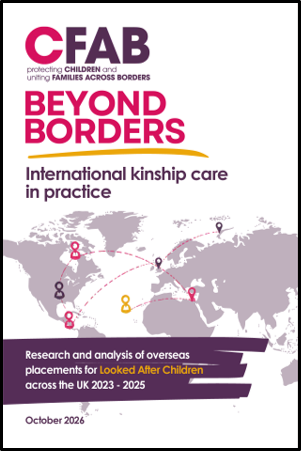
On 14 October CFAB published Beyond borders – international kinship care practice
Priorities
1. Make it visible
Improve national data collection and strengthen guidance on exploring family overseas.
2. Make it work
Ensure international placements are legally secure, safe and workable in practice.
3. Make it last
Embed international kinship care into future reform and ensure children and carers receive appropriate support across borders.
Reminders From Previous Weeks
Parents as Partners – A Better Start 3rd insight report
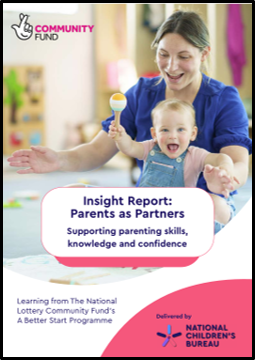
On 1 October NCB published its 3rd insight report: Parents as Partners
The report features case studies from Blackpool, Bradford, Lambeth, Nottingham and Southend-on-Sea
What works in practice:
- Combining evidence-based programmes with flexible support
Structured parenting programmes can be effective, but the greatest engagement came from combining them with tailored, co-designed support that responds to families’ changing needs. - Focusing on the issues that matter most to parents
Parents particularly valued practical help with everyday challenges such as healthy eating, oral health, financial wellbeing and building skills and confidence for employment. - Designing services around accessibility and parent feedback
Services were most successful when they adapted to parent feedback and reduced barriers to participation through measures such as local venues, childcare provision and multiple ways to access support. - Building trust through community and peer support
Trusted local organisations, parent volunteers and peer supporters were highly effective in reaching underserved families, strengthening engagement and making services more responsive. - Co-producing with benefits to all
Involving parents in the design and delivery of services improved the quality of support while also developing parents’ own skills, confidence, leadership and community connections.
Foundations Impact Rep[ort 2025-2026
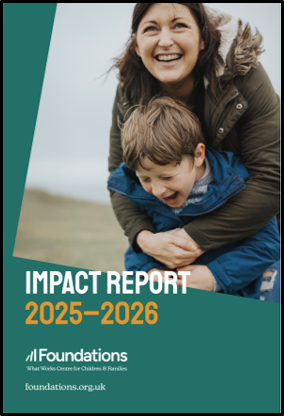
On 19 October Foundations – the what works centre for children and families published its Impact Report 2025-2026
Headlines
This year, our evidence helped shape some of the biggest reforms to children’s services in a generation. From influencing national policy to supporting local authorities across England to use evidence more effectively, our latest Impact Report shows how we are turning evidence into better decisions, services, and outcomes for children and families.
Inside the report, you’ll find stories from a landmark year for Foundations, including securing a further 10 years of funding, expanding our work to help local areas use evidence more effectively, building the evidence base on kinship care and support for children affected by domestic abuse, and ensuring lived experience remains at the heart of everything we do through our Experts by Experience panel.
Foundations webinar: Reunification Practice Guide
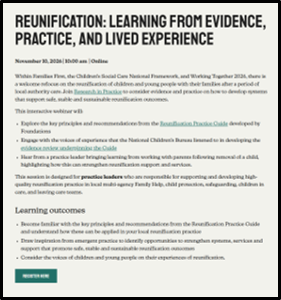
On 10 November 2026 Foundations (What Works Centre for Children and Families) is hosting a webinar Reunification: learning from evidence, practice and lived experience
10:00-12:00 Tuesday 10 November
This interactive webinar will:
- Hear from a practice leader bringing learning from working with parents following removal of a child, highlighting how this can strengthen reunification support and services..
- Explore the key principles and recommendations from the Reunification Practice Guide developed by Foundations
- Engage with the voices of experience that the National Children’s Bureau listened to in developing the evidence review underpinning the Guide
This session is designed for practice leaders who are responsible for supporting and developing high-quality reunification practice in local multi-agency Family Help, child protection, safeguarding, children in care, and leaving care teams.
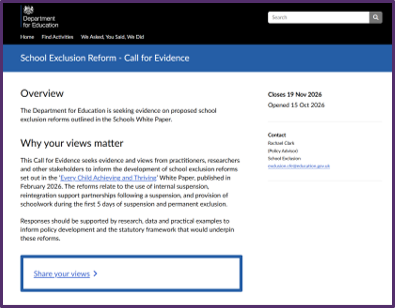
DfE call for evidence: School exclusion reform
On 15 October DfE published an open call for evidence on School Exclusion Reform
Closes 19 November
The reforms relate to the use of internal suspension, reintegration support partnerships following a suspension, and provision of schoolwork during the first 5 days of suspension and permanent exclusion.
Responses should be supported by research, data and practical examples to inform policy development and the statutory framework that would underpin these reforms.
Regional Improvement Plan 2026-27
On 14 July 2026 SESLIP published our regional improvement plan for 2026-27

Headlines
The regional improvement plan has 43 projects and a budget of just over £2m.
The plan incorporates our delivery plan for DfE’s RIIA grant of £1.5m to SESLIP for financial year 2026-27.
Tools & Templates
We have produced a Regional Improvement Plan (July 2025)
On 20 October Reseach in Practice invited professionals and care-experienced children and young people to respond to the consultation on draft children’s homes Career Standards for England
On 19 October Foundations – the what works centre for children and families published its Impact Report 2025-2026
On 15 October DfE published an open call for evidence on School Exclusion Reform. Responses are being collected here
On 14 October CFAB published Beyond borders – international kinship care practice
On 9 October ADPH published updated guidance on What Good Infant, Children, and Young People’s Public Health Looks Like
On 6 October Ofsted published an independent report from IFF, Evaluation of Ofsted’s renewed approach to education inspection: summary of interim findings
On 2 October DfE published updated statutory guidance for Kinship Care
On 1 October NCB published its 3rd insight report: Parents as Partners
On 1 October DfE published Universal RISE grants 2025 to 2026: case studies. Of 25 case studies, three feature south east authorities and/or schools
On 1 October DHSC published Children and young people’s alcohol and drug services: framework
On 29 September CSPRP published Q4 rapid review analysis: January to March 2026
On 27 September The Children’s Society published Red flags we don’t see: Missed signs and missed support in teenage relationships
On 24 September 2026 DfE published Children’s homes workforce knowledge and skills Rapid evidence assessment
On 16 September IPPR published A better deal: tackling the NEET crisis
On 14 September 2026 DfE published upodated guidance on School Food Standards
On 4 September 2026 DfE published Enduring Relationships
On 4 September 2026 Ofsted (and others) published new guidance on JTAI of the response to younger children living with neglect
On 25 August 2026 DfE published ‘You really are on your own’: a study of the early deaths of young people who were in care
On 20 August 2026 MoJ published Turnaround Programme Guidance version 5
On 19 August 2026 DfE published School belonging and attainment at key stage 4: linked data study
On 13 August 2026 DfE published updated guidance for LAs on Care Leaver Local Offer
On 5 August 2026 DHSC announced Major expansion of community mental health support across England
On 4 August 2026 the Office for Health Improvement and Disparities published updated technical guidance on data submission for the universal health visiting service: 2026 to 2027
On 26 July 2026 FRG published an evaluation of Dorset’s re-imagining pre-proceedings pilot and a new journey guide local family justice areas
On 23 July 2026 CSPRP published Adolescent Suicide. The child behind the story:understanding cumulative harm through lived experience
On 17 July 2026 Moj published Consultation on the oversight and funding of youth justice services. Online response form