

Newsletters
Our Regional Improvement Plan can be found here
If you would like to apply to be a SESLIP consultant you will need to register with Kent Business Portal and once you are registered, log in and navigate to “Response Manager” and the link to View Invites and Responses. The relevant Access Code is KT59CT449W which will take you to DPS – SC240046 – SESLIP – New Suppliers. Please follow the on screen instructions
Updates
Children’s social care improvement and intervention data model
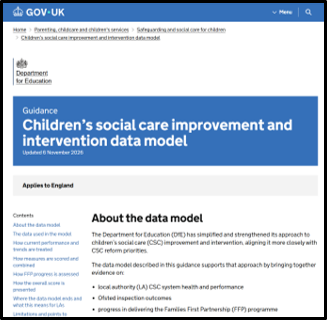
On 6 November DfE published Children’s social care improvement and intervention data model
Headlines
The DfE has simplified and strengthened its approach to children’s social care (CSC) improvement and intervention, aligning it more closely with CSC reform priorities.
The data model described in this guidance supports that approach by bringing together evidence on:
- local authority (LA) CSC system health and performance
- Ofsted inspection outcomes
- progress in delivering the Families First Partnership (FFP) programme
It provides a starting point for considering where further scrutiny, support or intervention may be needed.
Understanding CSC performance means recognising the complexity of local systems and the limitations of what can be captured through data alone.
Child Focused Courts Target Operating Model
On 28 October MoJ published Child Focused Courts Target Operating Model
Headlines
This document is intended to establish a shared understanding of the system-wide ambition and aspiration for the future of private law proceedings, via Child Focused Courts.
In March 2026, the government confirmed that Child Focused Courts, formerly known as the Private Law Pathfinder, will be rolled out across the entirety of England and Wales by March 2029.
This document provides a shared blueprint for reform, bringing together the vision, design, multi-agency approach and delivery requirements needed to implement Child Focused Courts consistently across England and Wales.
Planning Housing Pathways for Care Leavers
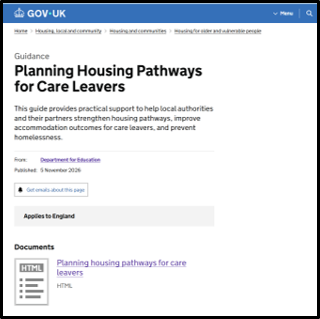
On 5 November DfE published Planning Housing Pathways for Care Leavers
Headlines
The guide will help local authorities and their local partners to strengthen housing pathways for care leavers, improve access to suitable accommodation, and prevent homelessness.
It provides practical advice and examples of effective practice to support children’s services, housing teams, commissioners and wider partners to plan housing earlier, work more effectively together, and ensure that care leavers have access to housing and accommodation that meets their needs.
The Care leaver homelessness reduction action plan includes further information.
Children, violence and vulnerability 2026
On 12 November YEF published Children, violence and vulnerability 2026.
The fifth annual report from the Youth Endowment Fund exploring young people’s experiences of violence.
Each year, YEF asks thousands of teenagers across England and Wales about their experiences of violence. This year they’re publishing the findings as a series of themed reports. Each one looks at a different side of how violence shapes children’s lives.
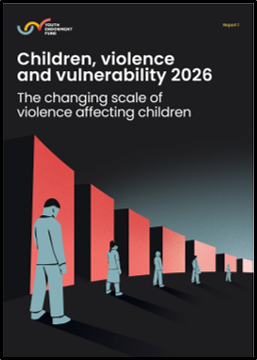
CEO Jeremy Miles, and Youth Advisory Board Members Jess and Elijah discuss the importance of embedding youth voice in our work – and why the importance of understanding children’s experiences of violence.
Reforming childhood criminal records disclosure
On 12 November MoJ opened a consultation on Reforming childhood criminal records disclosure
You can respond to this consultation online.
Closes 24 December
In the Youth Justice White Paper ‘Cutting Youth Crime, Changing Young Lives’, the Government committed to a public consultation on targeted areas of reform to childhood criminal records disclosure to ensure the regime is clear and proportionate.
We welcome responses from anyone impacted by having to disclose a youth criminal record, organisations working in the youth justice/criminal records sector, and employers and organisations that use criminal records disclosure to inform decisions, especially in relation to safeguarding.
Children Not in School statutory guidance
On 12 November DfE opened a consultation on Children not in school statutory guidance
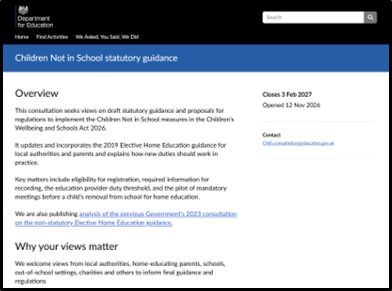
Closes 3 February
This consultation seeks views on draft statutory guidance and proposals for regulations to implement the Children Not in School measures in the Children’s Wellbeing and Schools Act 2026.
It updates and incorporates the 2019 Elective Home Education guidance for local authorities and parents and explains how new duties should work in practice.
Key matters include eligibility for registration, required information for recording, the education provider duty threshold, and the pilot of mandatory meetings before a child’s removal from school for home education.
DfE is also publishing analysis of the previous Government’s 2023 consultation on the non-statutory Elective Home Education guidance.
Elective home education guidance: 2024 consultation report back
On 12 November DfE published a review of the responses to a 2024 consultation on EHE
Headlines
4,310 responses were received to the consultation. The majority of these came from parent/carers of a child not registered at a school or college (62%, n=2,679), followed by parent/carers of a child registered at a school or college (16%, n=698). 3% (n=121) of responses were from a child or young person and 3% (n=113) from local authorities.
Of the 4,310 responses, 429 were identified as campaign responses (10% of all responses).
Online harms – three new briefing papers
On 9 November CSPRP published three new brifing papers on on line harms
Online harms as a growing safeguarding risk
Online harms, child sexual abuse and child sexual exploitation
Headlines
The Panel has developed a series of briefing papers to help practitioners and leaders understand how online environments can feature within children’s experiences of serious harm. The papers explore different aspects of online harm, with learning that may overlap across safeguarding contexts. They support routine enquiry, earlier recognition and coordinated responses, and can be used in supervision, team discussions and multi-agency learning.
Reminders From Previous Weeks
Off the radar: who are NEETs not claiming bebefits?
On 3 September IFS published “Off the radar: who are NEETs not claiming benefits?“
Key findings
- Hidden NEETs aged 22–23 are more closely attached to the labour market than NEETs claiming benefits.
- Hidden NEETs also have relatively good educational qualifications and health, which suggests that they are better placed to move into work than NEETs receiving benefits.
- Most hidden NEETs are supported financially by relatively well-off families.
- As a result, hidden NEETs are less likely to report financial hardship than those receiving benefits
- Our main data source covers NEETs aged 22–23, but our key findings hold more generally.
- The results suggest that investing substantial resources into identifying and tracking all hidden NEETs in a national database, as some have called for, would have limited returns.
- However, a sizeable minority of hidden NEETs have been NEET for a long time but are excluded from employment initiatives within the Youth Guarantee
APPG for Care-Experienced CYP: Inquiry Report
On 27 October Become published the APPG for Care-Experienced CYP Inquiry “How does the care system protect and support children’s relationships?“
How does the care system protect and support children’s relationships?
Too many children in care currently face multiple moves, often far from everything they know.
A shortage of suitable homes, foster carers and specialist support drives this instability, while weaknesses in planning and accountability means children’s important relationships are too often overlooked in care decisions.
The report follows a three-month long inquiry where we gathered evidence from over 170 young people, as well as professionals and organisations across the children’s social care sector.
Better Records Together: working together to improve the management of care records
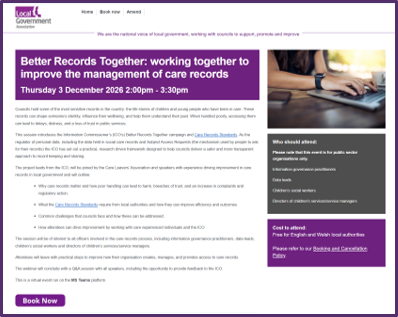
LGA is hosting an online seminar on Thursday 3 December: Better Records Together – working together to improvethemanagement of care records
Online – Thursday 3 December 2-2.30pm
This session introduces the Information Commissioner’s (ICO’s) Better Records Together campaign and Care Records Standards. As the regulator of personal data, including the data held in social care records and Subject Access Requests (the mechanism used by people to ask for their records) the ICO has set out a practical, research driven framework designed to help councils deliver a safer and more transparent approach to record keeping and sharing.
DfE call for evidence: School exclusion reform
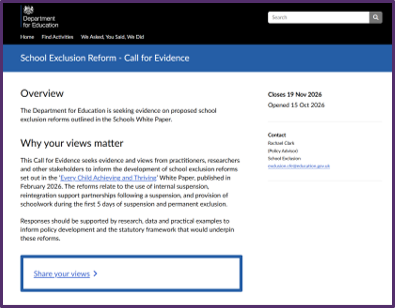
On 15 October DfE published an open call for evidence on School Exclusion Reform
Closes 19 November
The reforms relate to the use of internal suspension, reintegration support partnerships following a suspension, and provision of schoolwork during the first 5 days of suspension and permanent exclusion.
Responses should be supported by research, data and practical examples to inform policy development and the statutory framework that would underpin these reforms.
Regional Improvement Plan 2026-27
On 14 July 2026 SESLIP published our regional improvement plan for 2026-27

Headlines
The regional improvement plan has 43 projects and a budget of just over £2m.
The plan incorporates our delivery plan for DfE’s RIIA grant of £1.5m to SESLIP for financial year 2026-27.
Tools & Templates
We have produced a Regional Improvement Plan (July 2025)
On 12 November YEF published Children, violence and vulnerability 2026.
On 12 November DfE published a review of the responses to a 2024 consultation on EHE
On 9 November CSPRP published three new brifing papers on on line harms
On 6 November DfE published Children’s social care improvement and intervention data model
On 5 November DfE published Planning Housing Pathways for Care Leavers
On 28 October MoJ published Child Focused Courts Target Operating Model
On 27 October Become published the APPG for Care-Experienced CYP Inquiry “How does the care system protect and support children’s relationships?“
On 20 October Reseach in Practice invited professionals and care-experienced children and young people to respond to the consultation on draft children’s homes Career Standards for England
On 19 October Foundations – the what works centre for children and families published its Impact Report 2025-2026
On 15 October DfE published an open call for evidence on School Exclusion Reform. Responses are being collected here
On 14 October CFAB published Beyond borders – international kinship care practice
On 9 October ADPH published updated guidance on What Good Infant, Children, and Young People’s Public Health Looks Like
On 6 October Ofsted published an independent report from IFF, Evaluation of Ofsted’s renewed approach to education inspection: summary of interim findings
On 2 October DfE published updated statutory guidance for Kinship Care
On 1 October NCB published its 3rd insight report: Parents as Partners
On 1 October DfE published Universal RISE grants 2025 to 2026: case studies. Of 25 case studies, three feature south east authorities and/or schools
On 1 October DHSC published Children and young people’s alcohol and drug services: framework
On 29 September CSPRP published Q4 rapid review analysis: January to March 2026
On 27 September The Children’s Society published Red flags we don’t see: Missed signs and missed support in teenage relationships
On 24 September 2026 DfE published Children’s homes workforce knowledge and skills Rapid evidence assessment
On 16 September IPPR published A better deal: tackling the NEET crisis
On 14 September 2026 DfE published upodated guidance on School Food Standards
On 4 September 2026 DfE published Enduring Relationships
On 4 September 2026 Ofsted (and others) published new guidance on JTAI of the response to younger children living with neglect
On 25 August 2026 DfE published ‘You really are on your own’: a study of the early deaths of young people who were in care
On 20 August 2026 MoJ published Turnaround Programme Guidance version 5
On 19 August 2026 DfE published School belonging and attainment at key stage 4: linked data study
On 13 August 2026 DfE published updated guidance for LAs on Care Leaver Local Offer